

Around 55 leaders representing a wide range of Dorchester’s organisations, and Dorchester’s Member of Parliament Edward Morello, took part in an interactive workshop just before Christmas. Hosted by the Town Council, this was to look at options for Re:connection – an ambitious concept for a new community, business, creative and sustainability hub in the town centre, probably in a restored heritage building or buildings.
Setting the scene

Volunteer project manager Rob Hattersley started the event by outlining some key principles including:-
- This event was just the start – a full feasibility study or studies on specific premises would be needed and include more extensive co-design with both stakeholders and the wider public to ensure the best outcome
- Research suggests that hubs with multiple functions are more financially viable than those with a single function – being ambitious works if it is matched closely to both need and income streams
- The project will involve mapping gaps in provision in Dorchester and filling them, not competing with what already works well, which is why we need to map existing provision. That said, some stakeholders have already indicated interest in possibly relocating to a more affordable central hub
- Re:connection would aim to improve town footfall, supporting and signposting to existing retail, heritage attractions and community organisations
Addressing real needs
To stimulate discussion, Rob briefly outlined some of the needs which re:connection might be able to address, including: –
- Affordable access for all to food, social spaces, cultural experiences, clothing, children’s toys and play opportunities, devices and tools
- Connection and social cohesion, with a focus on recent trends including remote and home workers, online culture, silos and echo chambers, and a loss of spaces and processes involving human interaction
- Shared social and work spaces – for home and remote workers, a lack of places for collaborative work, and fewer opportunities to bump into colleagues, to solve problems, network, and build professional relationships
- Personal and community resilience – increasing numbers who have no-one to turn to in an immediate crisis, putting strain on public services, and limited community resilience to potential shared crises such as internet blackout, power cuts, food shortages or extreme weather
- A vibrant town centre – empty shops and buildings, struggling businesses, low footfall and competition with online, limited space for start ups and creative micro-businesses
- Support for young people – limited space for them just to ‘be’, loss of confidence and enjoyment in the real world for some, a lack of calm / supportive space for homework and self-directed study, things to do, work experience and life skill development
Case studies
Rob highlighted some examples of successful hubs around the UK, examples of which can be found here. Common success factors appeared to be:-
- Partnership not competition-based – filling gaps and doing things better
- Based on well researched local needs, with effort made to listen to those who are not always heard
- Seed or capital funding leads to a sellable quality product or service to generate operational income and a sustainable financial model
- Renewed heritage buildings, reviving high streets, bringing people together and back into town centres
- All about changing lives and rebuilding community, not the ‘thing’ or building itself
Facilitator Simon Standish then led groups at nine separate tables to consider a grid with the scale of need against current capacity. Attendees agreed where to place needs on the grid. This resulted in priority needs which were both significant and short on capacity, and thus where Re:connection might have the best impact.
On a second chart, groups placed all these top needs and discussed ways in which Re:connection might address them.
Simon then facilitated feedback from each group, and led a shared discussion as to both current provision and additional need.
Needs and priorities
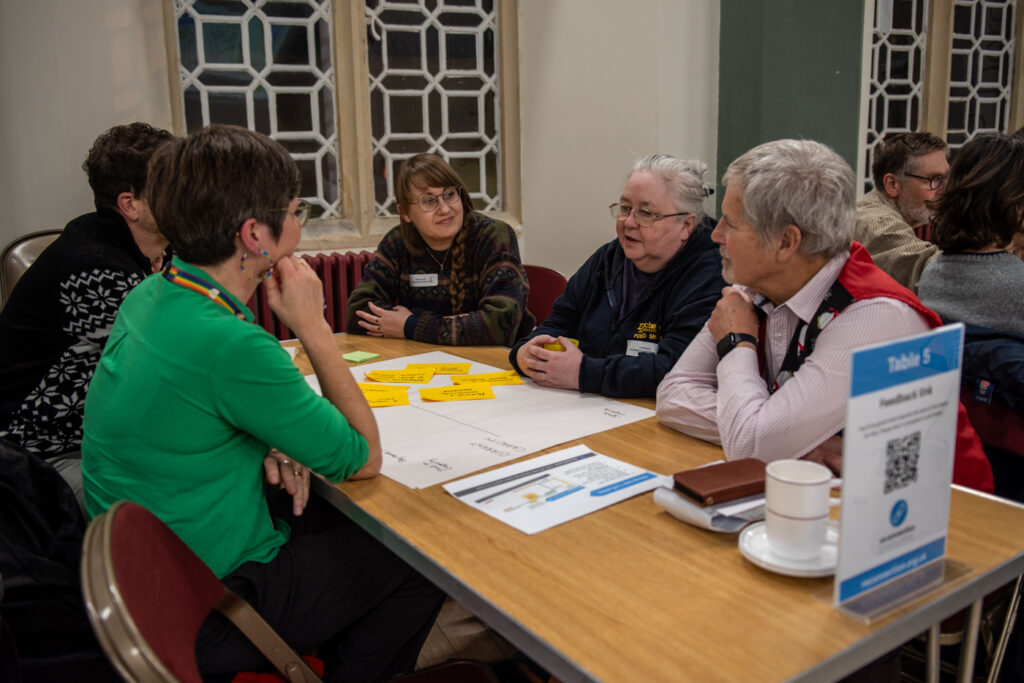
The following is a summary of discussion from each group on priorities and possible solutions which could be provided by Re:connection. Comments reflect the different views expressed and so may be contradictory – all these things will need ironing out as part of a collaborative process. There were also some instances of attendees outlining a need which already had a solution, but people were not aware of it. A hub could help with promotion: –
- Support for young people and families, and especially 18-24s – a drop in space for evenings and weekends easier to access than Fordington or Poundbury with both ‘social’ and ‘quiet’ (homework zone) areas; toy library; table top and video games club/zone; recording studio and/or soundproofed recording space; film club; mental health support; support for additional needs; climbing wall; volunteers who understand young people; parenting support; one group said the family hub concept in the library needs a more community-friendly location
- Shared workspaces, including equipment to help people run their own businesses such as 3D printing; creative studios; facilities and programmes for skills sharing including intergenerational connections, and on topics including IT, marketing and social media navigation; space for small start-ups; co-working spaces to rent; affordable meeting space also available in evenings;
- Affordable access to food, cultural and social experiences, sharing food from different cultures together; events for both specific age groups and needs, but also intergenerational; cookery skills and a kitchen for this alongside shared community cafe and social space; a community supermarket linked to the cafe (make shopping more social); games club encouraging intergenerational connections; need for food bank storage and refrigeration space; clothing bank/swap; clothing loan; provision of a ‘dry pub/ club’; support for those suffering from addiction;
- A vibrant town centre – a need for better tourist welcome and information to drive business; improved information for local residents (not replacing council information in the library, but specifically for office-based local charities and others for a ‘shop front’ to raise public awareness); promoting everything that is happening in town at one central location including volunteering opportunities and training; co-location of services in one central place where possible makes it much more convenient; access to in personal financial advice, support and services (banking hub); space for creatives and entrepreneurs to showcase their work
- Developing local skills, support and sustainability/cost of living – Men’s Shed and Repair Cafe (and storage space); job, work experience (e.g. in cafe), employability support and local business links including space & programme for volunteer mentors, people with disabilities, and neurodiverse; a digital skills & support hub – possibly offering accredited course in partnership with local providers; neurodiversity information, education and support hub; financial education hub; job centre point; circular economy collection point; renewable energy, retrofitting and carbon literacy advice point (this could be life-sized interactive)
- Health – preventative health checks, education and signposting – services are looking for town centre locations
Perhaps the best word submitted by an attendee was simply ‘hope’.

Funding and access
Questions were also asked about capital funding, and how the operation would make money. Rob briefly explained available capital funding streams, and how when each function would need to generate income to self-sustain from a mix of trading, rental, sponsorship, grants and membership. More work will be done on this but other examples prove it can be made to be viable. Parking and access was also raised and this will be considered as part of the feasibility study, bearing in mind differing needs including rural households, and those without cars.
The meeting concluded with a Q&A on the local needs and the national context for the project with Edward Morello MP, and a quick view of next steps from Rob including feasibility study, capital funding and build, and operations – which could take several years and a possible phased process.
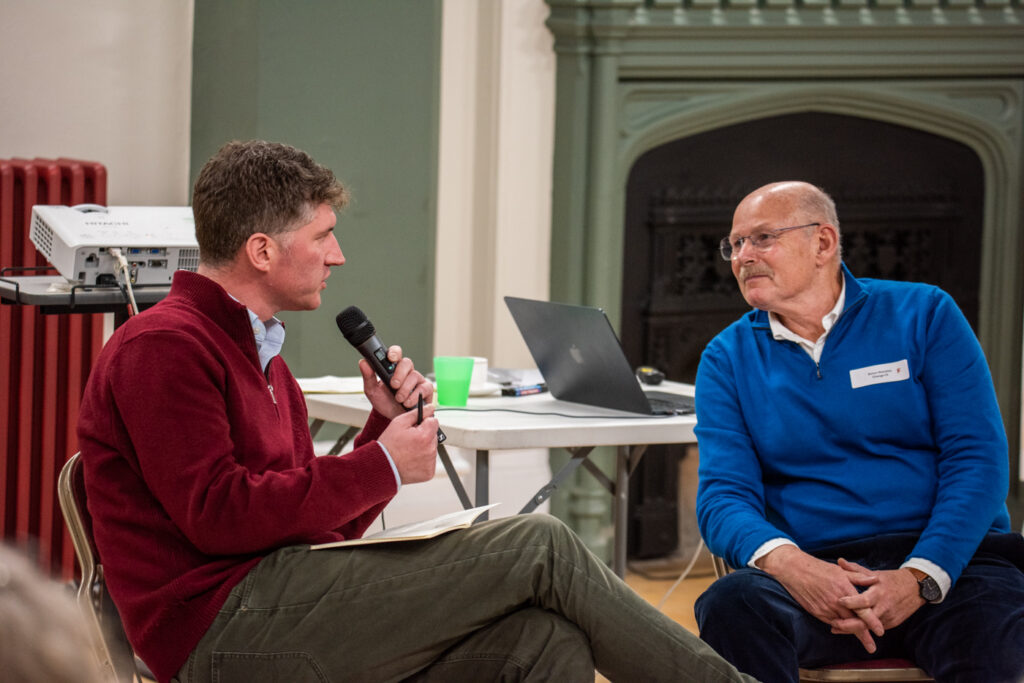
Edward commented: “I was really pleased to see such evident enthusiasm in the room to further improve community resilience in Dorchester, improve our town centre, support young people, and grow business. It is potentially a very exciting project, and I look forward to seeing how the plan develops, and how I might help.”
Rob concluded “We were thrilled with such a strong turnout on a dark December evening, demonstrating significant interest in and growing commitment to do something new and positive in our town centre. Huge thanks to the Town Council for their support, and to each attendee and organisation taking part. The findings will be invaluable as we take the project forward into 2026.”
Attendees completed a feedback survey and expression of future interest and responses to this will be followed up in the coming weeks.
With thanks to Fenris Oswin for the photography.
